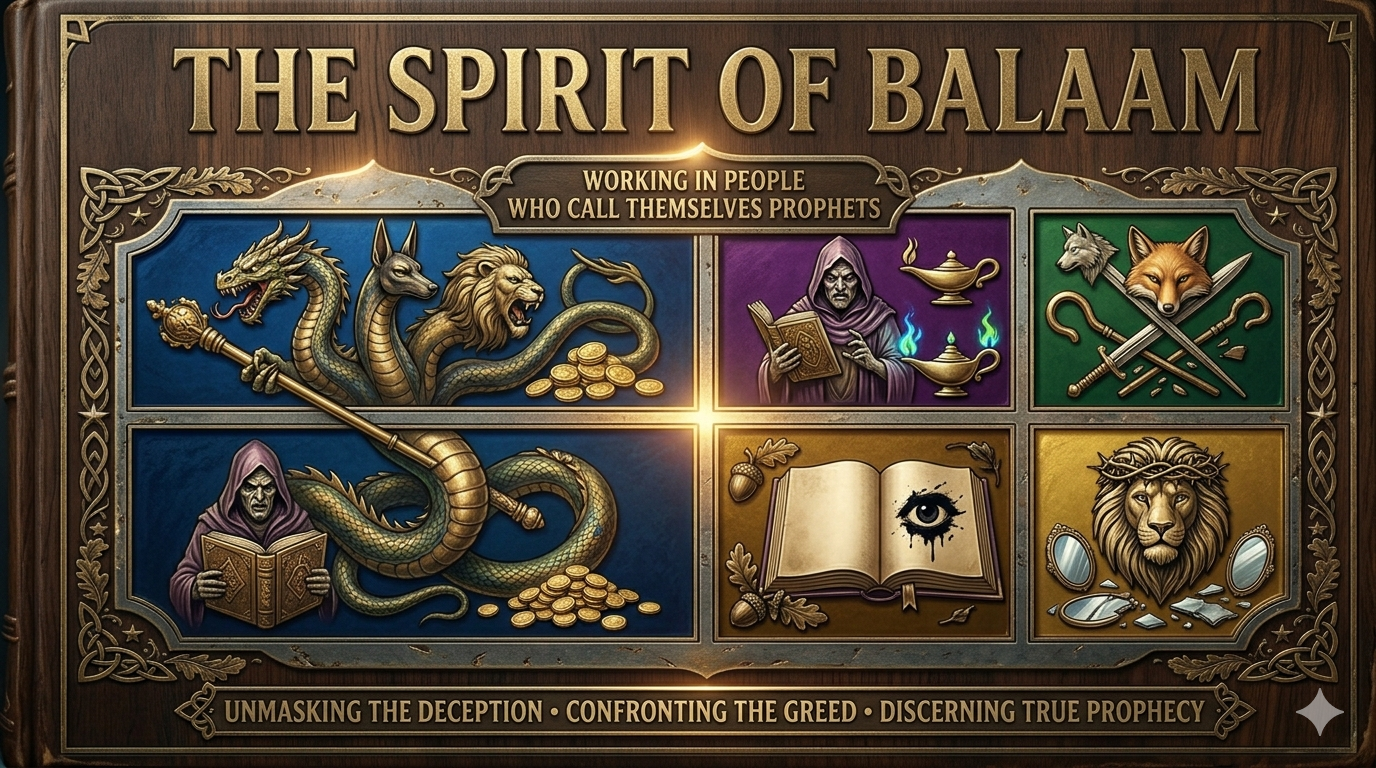
The Spirit of Balaam Working in People Who Call Themselves Prophets
Many people claim to be prophets, but not every prophetic voice comes from God. Some speak with spiritual language, revelation-like words, and unusual manifestations, yet their source, motive, and character do not reflect the Spirit of God. One of the clearest biblical patterns for this is Balaam.
Balaam was not a true prophet in the covenantal sense of being aligned with God’s heart. He had access to spiritual experiences, but his heart was corrupt. He could speak about God, hear spiritual things, and appear powerful, yet inwardly he was compromised. That is what makes the spirit of Balaam dangerous. It can operate around sacred things while remaining opposed to God’s true purpose
Who was Balaam?
Balaam appears prominently in Numbers 22–24. He was consulted because people believed he had spiritual power to bless or curse. Outwardly, he looked like a man with access to the spirit realm. But the deeper story shows that he was driven by reward, influence, and compromise. Later Scripture exposes him more clearly.
Key passages:
● Numbers 22–24
● Numbers 31:16
● 2 Peter 2:15
● Jude 1:11
● Revelation 2:14
These passages reveal Balaam as a man who:
● loved the wages of unrighteousness,
● used spiritual authority for gain,
● taught compromise,
● and became a corrupter of God’s people
What is the spirit of Balaam?
The spirit of Balaam is a corrupt prophetic spirit that seeks to use spiritual gifts, revelation, influence, or ministry appearance for selfish ends. It is not the Spirit of God. It is a pattern of deception where a person may sound spiritual, look prophetic, and even operate in unusual manifestations, yet be moved by greed, manipulation, pride, compromise, or hidden darkness.
It is dangerous because it can appear close to truth while working against truth.
Main marks of the spirit of Balaam
1. Spiritual appearance without true surrender to God
Balaam could speak in ways that sounded elevated and spiritual, but his inner life was not aligned with God. This is one of the first signs. A person may know prophetic language, religious vocabulary, and spiritual theatrics, but their life is not submitted to God.
A true prophet is not just someone who speaks spiritual things. A true prophet belongs to God.
2. Love of money and reward
This is one of the strongest marks.
2 Peter 2:15 says Balaam “loved the wages of unrighteousness.”
That means his heart was captured by gain. He was willing to use spiritual function for personal benefit.
When the prophetic becomes a business of exploitation, fear-selling, manipulation for offerings, payment for access, or monetising people’s pain, the pattern of Balaam is present.
A true prophet may receive support, but he does not merchandise the anointing.
3. Desire to please men while pretending to serve God
Balaam kept trying to balance what God said with what powerful men wanted. He wanted both spiritual credibility and human reward. He wanted to appear obedient while still entertaining corruption.
This is a major sign of false prophetic operation: they do not stand for God alone. They adjust truth to keep influence, platform, money, or followers.
4. Use of spiritual insight without purity of heart
Balaam had some level of spiritual perception, but perception is not the same as holiness. A person can be spiritually sensitive and still be morally corrupt.
This is where many people are deceived. They think:
● accurate words mean true prophet,
● strange manifestations mean divine backing,
● spiritual information means godly source.
That is false.
Accuracy alone does not prove divine approval. The source, fruit, doctrine, motive, and character must be tested.
5. Leading God’s people into compromise
Revelation 2:14 and Numbers 31:16 show that Balaam’s influence ultimately led God’s people into corruption.
This is crucial. The spirit of Balaam does not only want admiration. It wants contamination.
A false prophet under this spirit will gradually lead people into:
● sensual corruption,
● soul ties,
● spiritual dependence on the prophet,
● idolatry of personalities,
● compromise with sin,
● mixture of truth and error.
A true prophet leads people to God. A Balaam-type prophet leads people into bondage while appearing spiritual.
6. Manipulation through blessing, curse, fear, and control
Balaam was connected with the idea of spiritual power over outcomes. This is why many Balaam-type ministers use fear and control. They make people believe:
● “Without me, your life will not move.”
● “If you leave this ministry, something bad will happen.”
● “You need this special seed for your breakthrough.”
● “Your enemies will destroy you unless I intervene.”
This is not the spirit of Christ. That is spiritual control.
The true prophetic reveals Christ and brings people into truth, freedom, holiness, and obedience to God.
7. Mixture
The spirit of Balaam thrives on mixture. It mixes:
● truth with error,
● revelation with carnality,
● gifts with corruption,
● divine language with demonic motive.
This is why it is hard for undiscerning people to detect. Everything is not completely false. There are fragments of truth. But the overall stream is polluted.
Poison does not need to be the whole cup. A little mixture is enough.
How to discern a true prophet from a Balaam-type prophet
1. Check the fruit, not just the gift
Jesus said we would know them by their fruits. Not by their titles. Not by their charisma. Not by the excitement around them.
Ask:
● Does this ministry produce holiness?
● Does it produce truth?
● Does it point people to Christ?
● Does it make people spiritually mature?
● Does it bring liberty or dependence?
2. Check the motive
A true prophet seeks God’s glory.
A Balaam-type prophet seeks gain, influence, admiration, and control.
Ask:
● Is there constant pressure around money?
● Is ministry built around self-exaltation?
● Are people being used?
3. Check their doctrine
No matter how dramatic the manifestations are, if the doctrine is corrupt, the source is wrong.
A true prophet will uphold:
● the Lordship of Christ,
● repentance,
● holiness,
● truth,
● obedience,
● the authority of Scripture.
A Balaam-type prophet may speak of power, breakthroughs, angels, enemies, and secrets, yet avoid repentance, holiness, and submission to Christ.
4. Check whether they draw people to God or to themselves
A true prophet becomes a signpost.
A false prophet becomes the destination.
If people fear the prophet more than they fear God, honour the prophet more than Christ, or depend on the prophet more than Scripture and the Holy Spirit, corruption is already at work.
5. Check their relationship with compromise
Balaam’s spirit tolerates compromise for advantage.
Ask:
● Do they confront sin or excuse it?
● Do they live one way publicly and another privately?
● Do they protect truth even when costly?
What is a true prophet of God?
A true prophet is not merely a predictor. A true prophet is a servant of God whose life, message, and spirit are aligned with God’s nature and word.
A true prophet:
● speaks from submission to God,
● honours Scripture,
● exalts Christ,
● walks in humility,
● refuses corruption,
● does not exploit people,
● calls people to repentance and alignment,
● and is broken before God before speaking to men.
The true prophetic is not performance. It is stewardship.
Why many people are deceived
Many believers judge by manifestation instead of by nature. They are impressed by:
● predictions,
● mysteries,
● spiritual vocabulary,
● dramatic deliverance scenes,
● claims of angels and encounters.
But Scripture warns clearly that deception can wear religious clothing.
The issue is not whether something looks supernatural.
The issue is whether it is from God.
Warning to the Church
The spirit of Balaam is especially dangerous in times when people are desperate for answers, miracles, prophecy, and solutions. In such seasons, many will tolerate corruption if they believe a man can solve their problem.
But desperation without discernment leads people into captivity.
The Church must recover biblical discernment. Not every voice is from God. Not every seer is sent by God. Not every prophet is a prophet of God.
How believers should respond
Believers must:
● return to Scripture,
● test every spirit,
● stop being impressed by outward power alone,
● value holiness as much as gifting,
● refuse prophetic manipulation,
● and remain anchored in Christ.
Discernment is not rebellion. It is protection.
Strong conclusion
The spirit of Balaam operates where spiritual power is desired without true holiness, where ministry is used for gain, and where God’s people are manipulated instead of formed. A person may call himself prophet, but if his life is ruled by greed, compromise, control, mixture, and corruption, he is not functioning by the Spirit of God.
The true prophet of God does not merely amaze people. He aligns people with God.
The Church must stop asking only, “Is he powerful?”
The Church must ask, “Is he true?”
Not, “Can he see?”
But, “Who sent him?”
Not, “Does he sound prophetic?”
But, “Does his life, doctrine, and fruit agree with God?”
That is how the spirit of Balaam is exposed.
Key Scriptures for teaching
● Numbers 22–24
● Numbers 31:16
● Deuteronomy 18:20–22
● Matthew 7:15–20
● 2 Peter 2:15
● Jude 1:11
● Revelation 2:14
● 1 John 4:1
Short punchy statement for flyer or caption
Not every prophetic voice is from God. Some carry the language of heaven but the motive of corruption. The spirit of Balaam speaks spiritually, but works against truth, holiness, and God’s purpose. Discern the source. Test the fruit. Follow Christ, not mere manifestation.